Skin Tags ICD-10 Codes: Billable vs. Non-Billable
November 6, 2026
November 6, 2026
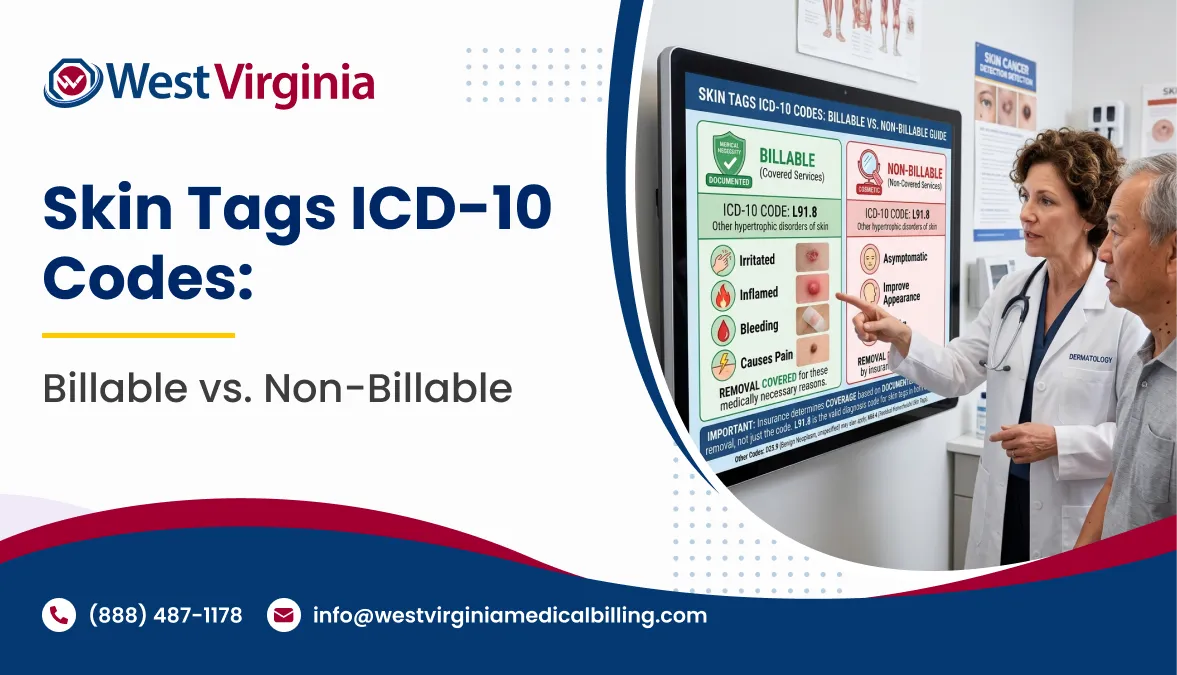
Skin tags may appear like harmless lesions, but their diagnosis and treatment can cause issues when it comes to coding. Incorrect ICD-10-CM code selection, not establishing medical necessity, or use of an incorrect procedure code can result in claim denial or rejection.
The main ICD-10 code for skin tags (acrochordon) is L91.8 and represents other hypertrophic skin disorders. This is a billable code in FY 2027. Still, the parent code L91 is non-billable and requires further clarification.
The knowledge of skin tag ICD-10 codes: billable and non-billable will be useful for physicians, dermatologists, and coders in order to separate legitimate codes from billing needs.
Healthcare professionals normally apply L91.8 – Other hypertrophic disorders of skin for the documentation of the existence of acrochordon or skin tag.
These are non-cancerous soft growths that mostly form on skin folds such as the neck area, eyelids, underarms, and other locations. They can be removed if they become irritants, bleed, or interfere with functioning.
L91.8 is classified in ICD-10-CM as hypertrophic disorders of the skin.
| ICD-10-CM code | Description | Billable status |
| L91.8 | Other hypertrophic disorders of the skin | Billable |
| L91 | Hypertrophic disorders of skin | Non-billable |
| L91.9 | Hypertrophic disorder of skin, unspecified | Billable |
| L91.0 | Hypertrophic scar | Billable; not the standard code for a skin tag |
For FY2027, the L91.8 diagnosis code remains as an acceptable code. CMS considers the period from October 1, 2026, to September 30, 2027, as the FY2027 code period.
Notably, the existence of a diagnosis code that is payable does not necessarily result in payment from an insurance company.
It is based on the completeness of the code.
A billable ICD-10-CM code has all the information necessary to diagnose a particular case on a medical insurance claim form. A non-billable category includes similar conditions; however, it is not an appropriate classification code because the classification necessitates a more specific child code.
For instance, code L91 is used for hypertrophic skin diseases generally. One should not use the L91 classification code to submit a diagnosis for the described disease. L91.8 is used as the classification for the particular condition.
But L91.9 indicates an unspecified hypertrophic disease. The code is billable. Nevertheless, it is not always applicable in case the medical report indicates skin growth.
In case the physician identifies an acrochordon, the L91.8 code will be more applicable.
In cases where the category codes are not fully complete, there is likely to be rejection of the claims even before the payer checks the eligibility of the service for clinical coverage.
Thus, the billing departments have to answer two distinct questions regarding the claims: Is the diagnosis code valid, and does the documentation support the service?
Acrochordon is the medical terminology used to refer to skin tags. Clinicians generally identify such benign tumors during a physical examination.
In cases where coding is necessary, it is best if the diagnosis of such tumors is provided by the clinician.
The important information in a clinical note is as follows:
An example would be the physician’s notation that there is a skin tag on the neck of the patient that keeps getting caught in the clothes and causing bleeding.
This provides far more information to the billing department than “Skin lesion removal.”
The FY2027 ICD-10-CM guidelines stress the importance of proper documentation and coding based on the established diagnosis.
The first frequent error in billing is the confusion of the diagnosis with the procedure.
ICD-10-CM codes identify the diagnosis, while CPT codes identify the procedure.
A provider will be able to document the L91.8 diagnosis and use an appropriate CPT code during the removal of a skin tag.
| CPT code | Procedure description | Reporting guidance |
| 11200 | Removal of skin tags, up to and including 15 lesions | Report one unit for the first 1–15 tags |
| 11201 | Each additional 10 skin tags, or part thereof | Report as an add-on to 11200 |
The series of CPT codes covers the removal of skin-tags regardless of the location in the body. However, unlike other skin-related operations, these codes base the measurement on the number of tags and not on the size of the lesion.
Furthermore, CMS instructs medical practitioners to use CPT 11200 as one unit and CPT 11201 for additional groups of lesions.
| Tags removed | CPT reporting |
| 6 | 11200 × 1 |
| 15 | 11200 × 1 |
| 16 | 11200 × 1 + 11201 × 1 |
| 25 | 11200 × 1 + 11201 × 1 |
| 26 | 11200 × 1 + 11201 × 2 |
These examples only serve as examples of CPT coding by volume rather than as guarantees of coverage or payment.
Further, coders should be careful to not choose CPT codes 17110 and 17111 for common skin tag removals. This is because these CPT codes usually cover the destruction of benign lesions except skin tags and cutaneous vascular lesions.
Medicare, in general, does not cover cosmetic removal of benign lesions from the skin. However, the symptoms or functional problems of the patient may qualify him/her to get coverage based on medically necessary grounds.
The relevant Medicare Administrative Contractor guidelines are as follows:
The physician is responsible for documenting the findings. Simply identifying a skin tag located in an anatomically delicate location does not guarantee coverage.
Also, Medicare contractors may have varied local coverage determination policies. It is advisable to review the appropriate LCD, billing article, and payer specific diagnosis requirements before submission.
Think of two individuals seeking skin tag excisions.
The first individual wants the skin tags to be removed because he/she feels uncomfortable about his/her appearance. There is no evidence of any bleeding, irritation, pain, or dysfunction noted. In this case, Medicare would consider it a cosmetic procedure.
In the other case, the individual complains of recurrent bleeding due to the tag getting caught on clothes. Here too, there are no physical findings in dispute.
Both cases may involve the same ICD-10-CM code.
However, the two are different in terms of coverage.
Coding L91 instead of a proper billable child code can be a source of preventable denial.
The coding program needs to check that the diagnosis code is complete prior to claims submission.
According to CPT 11200, 15 tags are coded first, and CPT 11201 is coded in case the physician removes over 15 tags.
Thus, if a billing department uses 3 units of 11200 for 30 tags, they make the mistake of quantity.
Sometimes, patients require skin tag removal due to comfort or appearance. The diagnosis cannot convert the cosmetic surgery into a covered procedure.
Prior to the procedure, it is important to know the payer criteria and the patient responsibility process.
Descriptions such as “irritated skin tag” do not adequately justify medical necessity.
What causes the irritation, the clinical manifestations, and pertinent physical examination findings should be described by the physician.
For instance, recurrent bleeding and associated inflammation are more clinically specific descriptions of irritation than just “irritation.” The Medicare Coverage Guidelines caution against justifying medical necessity based on vague irritation.
Removal of Benign Skin Lesion (L35498)
An office visit is not warranted in a skin tag removal procedure.
The physician needs to provide a significant, identifiable E/M service if one is performed. The coders need to consider present instructions on CPT, global surgery, and use of modifier 25.
A patient comes into the office of a dermatology practice due to skin tags catching onto clothes frequently and causing irritation and bleeding.
In this case, the provider records eight skin tags, the location of each one, and the irritation.
When searching for the right codes, the coding department uses L91.8 and CPT 11200. Then they check the appropriate payer policy to ensure the necessity of the procedure.
The patient asks the provider to remove 20 skin tags that do not bother him.
From the perspective of CPT quantity guidelines, the codes used will be 11200 and one unit of 11201. Nonetheless, there is no documentation of any symptoms on the part of the provider.
A doctor examines a patient and finds a suspicious skin lesion which does not seem like an ordinary skin tag.
The doctor opts to biopsy the skin lesion and not just remove it as part of cosmetic surgery for skin tag.
In this case, the coder needs to adhere to the diagnosis made, the procedure performed, and outpatient coding rules. The coder is not supposed to assign L91.8 when the lesion appears raised.
An effective workflow begins even before the doctor conducts the procedure.
Firstly, registration should ensure the patient’s eligibility and review their benefits. Additionally, they should establish any cosmetic exclusions and check whether further authorization and documentation are needed from the payer.
Secondly, the doctor should document diagnosis, symptoms, examination, lesion count, anatomical sites, and method of the treatment.
Finally, the coders will cross-reference the diagnosis and procedure conducted. They should ensure that the count of the lesions supports the units reported.
Before submitting the claim, billing should ensure the right coverage guidelines and coding rules, as well as the patient’s responsibility. The payment posting team will also monitor denials in order to find out any common documentation issues or mistakes in code selection.
This collaborative approach will help clinics minimize unnecessary claim adjustments and maintain correct medical records.
More is involved in skin tag coding than just choosing an appropriate code. L91.8 is used for other skin hypertrophic conditions and frequently codes acrochordon; L91 is the non-billable parent category for this code.
The removal codes, CPT 11200 and 11201, dictate quantity-based reporting for the procedure. But reimbursement also is based on necessity, documentation, payer guidelines, and proper claim filing.
Those physicians who understand the above criteria can solve any coding problems prior to any billing ones.
The most common ICD-10-CM code for skin tags is L91.8, which is classified as other hypertrophic diseases of the skin. This is a billable code for FY2027.
Yes. L91.8 is billable and is a valid code for FY2027. But a valid code doesn’t necessarily mean that there’s insurance coverage for the procedure.
The ICD-10 code L91.8 is applicable if the patient has acrochordon, and providers can use this code if their diagnosis is confirmed.
CPT code 11200 covers the excision of up to 15 skin tags. CPT code 11201 applies for any additional 10 or fraction thereof skin tags.
Medicare would cover removal when supported by documented indications for medical necessity. Removal of skin tags for cosmetic purposes will not be covered.
An E/M service can be billed separately when it satisfies the criteria for a separately identifiable E/M service.
No. L91.9 is used to code for hypertrophic disorder of skin unspecified while L91.8 is used to code for other hypertrophic disorders of skin.
Skin tag coding is more than just picking an ICD-10-CM code that can be billed. Even when L91.8 codes for acrochordons, physicians must justify necessity, choose the correct CPT code, and meet other payer requirements. Distinguishing between cosmetically motivated procedures and medically necessary ones is another factor that will help billing departments to avoid unnecessary claim denials.
Through proper documentation and coding verification, dermatologists can enhance the efficiency of their claims process and ensure better revenue cycle management.
Incorrect ICD-10 codes, unsupported removal procedures, and missing documentation can delay dermatology claims. West Virginia Medical Billing helps practices improve coding accuracy, resolve denials, and simplify claim management.