Medical Billing Audit Checklist: Guide for Healthcare Practices
November 2, 2026
November 2, 2026
The claim may not trigger any error message when sent via the billing software but the claim may still have an un-supported procedure code, wrong modifier or even outdated insurance information. In the event that the payor detects that you have committed such an error, the claims would have been subjected to denial, adjustment of payment or documentation.
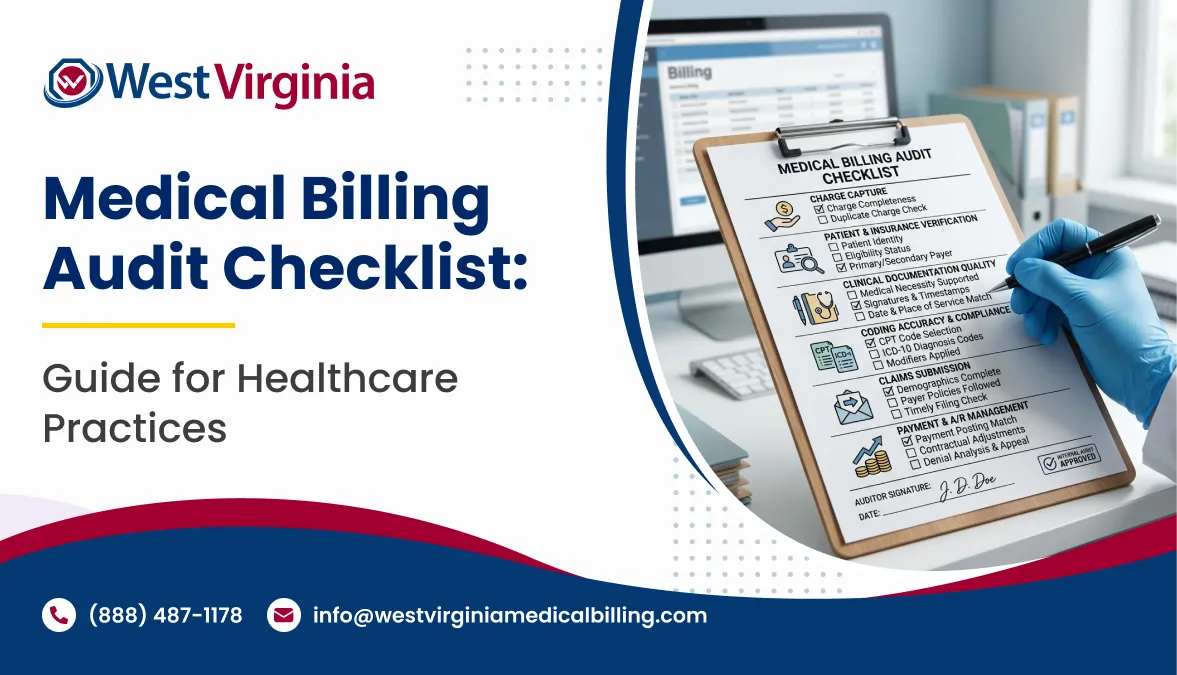
An audit checklist for medical billing may prove to be an important aid for medical practices as it helps in the analysis of the patient information, clinical information, medical codes, claims, payment process and adherence to the paying guidelines.
As a doctor, billing manager or practice administrator, the objective is not only identifying the errors. Through a proper auditing process, you will get to understand the reasons behind these errors.
A medical billing audit is an activity which involves the analysis of the claims, documentation, coding, and payments of the claims.
The audit will establish if there was correct billing and correct documentation of the charges for the services provided.
The three major areas of the audit are:
Coding – Is the coding right according to the documentation as per the codes of CPT, HCPCS, ICD-10-CM, and modifiers?
Coverage and billing – Can the billing be able to meet the coverage, medical necessity, authorization, and billing criteria?
Payment – Does the payor follow the correct payment procedure in handling the billing?
The audit has to cover the whole billing lifecycle and not just the denied/ rejected claims.
A billing error does not mean that the insurance provider will automatically deny the claim. There are times that the claim is accepted without proper documentation and/or a wrong code.
According to the CMS FY 2025 Improper Payments Fact Sheet, An estimated percentage of improper payments for the Medicare Fee-for-Service is 6.55% that constitutes $28.83 billion.
This percentage involves different payment errors and is not considered a fraud rate.
For health care providers, this means that it is essential to check claims rather than trust payments only.
Regular medical billing audits can help the practice:
The most successful audit systems use this information to improve processes so that errors are less likely to be repeated.
Use the below checklist to review the key steps in your revenue cycle. Each point below shows what needs to be reviewed by the reviewers as well as what issues need to be investigated further.
The first step that you need to review will be patient information because even the correct service coding can experience payment issues when the claim includes incorrect patient demographics or insurance information.
Audit checklist:
Finding: The patient switches insurance companies, yet the front office still uses the old insurance. The billing staff submits a claim to the old insurance company and gets a denied claim response.
Solution: Set up verification points to ensure eligibility before visits.
The documentation in the patient’s chart must support the services and claims made in the claim form. While reviewing, please ensure that the documentation in the patient’s chart is compared with the billed services..
Audit checklist:
General finding: The practice utilizes an elevated E/M code while the patient’s medical record does not document the required level of decision making or total time.
Resolution steps: Providers need to be educated on the E/M criteria and specific encounter reviews should be conducted to find recurrent discrepancies.
A good chart note describes a patient’s treatment; it is not just a billing note.
Coding errors could be made due to employees making use of outdated code selections, incomplete information or incorrect assumptions on what is expected by the payers.
Checklist for audit purposes:
For example, the doctor is performing two procedures on the same individual during the same encounter without thinking of adding an edit between the two procedures for coding purposes. The payer denies one procedure since the procedure does not meet the payer’s coding guidelines.
The reviewer should check the documentation, pertinent edits, and modifiers before editing the claim.
CMS maintains NCCI resources covering procedure-to-procedure edits and medically unlikely edits.
Problems with authorization could result in extra administrative effort being put into place, particularly for those fields that involve frequent processes.
Checklist for an audit:
Remember that prior authorization does not assure payment. It is only the first step in the payment process.
For a clean claim, correctness of procedure codes is not enough.
Billing identifier errors, date of service or place of service errors could lead to delayed claims processing despite proper supporting clinical documentation.
Audit checklist:
Tip: Separate rejections and payer denials on the audit report. Clearinghouse rejection is something that happens prior to payer claim processing, whereas the denial is something that comes after payer claim processing.
The audit process does not end when the payment is released from the payer.
Billing personnel must check to see if payments, contractual adjustments, and balances are entered accurately.
Audit checklist:
For example, a payer releases a payment lower than expected under the contract. Failure to check the difference could mean a recoverable underpayment is overlooked.
An audit of a payment requires checking for meaningful differences between the real transaction and the contract details.
Denial audits pinpoint situations in which claim audits would have difficulties finding issues. Instead of conducting audits on claims that were denied individually, conduct an audit of the denials on a grouped basis according to the type of denial, payer, procedure or process.
Audit checklist:
Highly recurring eligibility denials could be an indication of registration issues, and not coding issues. Likewise, recurring documentation denials could be an issue for staff training, rather than billing edits.
| Audit Area | What to Review | Common Risk |
| Patient registration | Demographics and active coverage | Incorrect payer information |
| Documentation | Encounter notes and medical necessity | Unsupported services |
| Medical coding | CPT, HCPCS, ICD-10-CM, modifiers | Incorrect or conflicting codes |
| Authorization | Approvals, dates, visit limits | Missing authorization |
| Claims submission | Identifiers, units, service dates | Rejections and filing delays |
| Payment posting | ERA/EOB and contractual adjustments | Underpayments |
| Denial management | Denial reasons and follow-up | Repeat denials |
| Compliance | Policies, records, corrective actions | Unresolved compliance risks |
Practices can adapt this table to their specialty, payer mix, claim volume, and internal compliance responsibilities.
A good audit of medical bills is conducted in a systematic manner. Without setting a scope and making any corrections, it’s all for nothing.
Identify the type of claim, provider, payer, and/or service that will be audited. An office can opt to audit denied cardiology claims, high dollar E/M services, or chronic authorization problems.
Claims are to be picked from multiple providers, payers, services and payment outcomes. Discuss a select few claims as well as a review of high-risk services or unusual billing practices. It is not always possible to fix the number of claims up front.
Look at claims, clinical, coding, authorization documents and payment data.
Compare claims with the service requirements as they existed on the date of service.
Describe a particular discrepancy, its reason and consequences.
A good audit should separate out the documentation errors, coding problems, payment inconsistencies, and the inability to comply with the rules.
Determine a person responsible for each problem.
These actions may include training, updating billing systems, physician education, claim correction and conducting a compliance audit.
Perform a follow up audit of claims or processes following the implementation of appropriate measures.
In case of repeated problems, it is necessary to investigate processes and not train employees once again.
Both approaches serve a purpose, but they offer different operational advantages.
| Internal Audit | External Audit |
| Uses staff or internal compliance resources | Uses independent reviewers |
| Supports regular operational monitoring | Offers an outside assessment |
| Helps identify routine workflow errors | Can identify overlooked risks |
| Allows faster feedback to billing teams | May provide specialized expertise |
| May face internal resource limitations | Requires careful coordination and record access |
A healthcare practice may decide to conduct periodic internal audits and/or an external audit if it identifies issues that are complex in coding, has a high frequency of reimbursement errors, or has compliance problems.
The following are some of the common medical billing audit mistakes:
If the billing folks don’t take time to consider where the problem is coming from, these folks are the ones who can get in the way of the audit process.
Audit based on only denied claims: Claims that have been accepted and paid could be audited incorrectly. All paid, adjusted and denied claims should be included in the auditing process.
Ignoring date of service guidelines: Using current coding guidelines on previous claims could yield wrong conclusions. The audit must be conducted in accordance with the relevant codes and policies to the claim being audited.
In the coding component alone: Coding matters; however, other factors like eligibility, authorization, posting and follow up may also be relevant for the claim.
Failure to act on action documentation: If an audit report is not followed up and acted upon after the audit, it becomes a worthless document.
If they think there was a payment error, they don’t assume it was a fraud: If they believe that the payment has been misplaced, they do not assume it was a fraud.
The schedule of performing audits may vary from one practice to another and is at their discretion to perform internal audits as well as an external audit of their choice.
A practical way would be conducting periodic and occasional audits.
Weekly audits: Look into the causes behind rejections and denials and any oddity in claims.
Monthly audits: Analyze sample claims, coding mistakes and discrepancies in payments.
Quarterly audits: Discover trends among the providers, specialty and payers.
Annual audits: Evaluate the billing policies and compliance issues and corrections of past audits.
These are suggested time durations and not the frequency for conducting federal audits.
Healthcare organizations are supposed to conduct audits frequently in case of introduction of new services and any change in the organization like billing anomalies.
The HHS Office of Inspector General identifies auditing and monitoring as important elements of an effective compliance program.
The final audit report should help practice leaders measure progress.
| Metric | What It Reveals |
| Coding error rate | Frequency of coding discrepancies in reviewed claims |
| Initial denial rate | Claims denied during initial payer processing |
| Clean claim rate | Claims passing defined initial submission checks |
| Days in accounts receivable | Average time receivables remain outstanding |
| Underpayment variance | Differences between expected and actual allowed payments |
| Corrective action completion | Progress toward resolving audit findings |
Consistently monitor these metrics and keep track of how the practice computes each one.
An increasing denial rate, for instance, indicates possible issues at the front end, while a growing aged receivables rate indicates possible follow-up problems.
Looking at several metrics provides a better assessment of how well the billing is being done.
A medical billing audit checklist needs to incorporate patient registration, insurance verification, documentation, coding, prior authorization, claims submissions, payments postings, denial management, and compliance.
Medical billers, coders, supervisors, internal compliance officers, or external auditors can conduct such reviews depending on the objective of the audit.
It depends on the number of claims, availability of documentation, scope of the audit and its complexity. A focused medical billing audit can require significantly less effort compared to a general compliance audit of an entire facility.
The audit can be used to determine the repetitive causes of denials, which are coding errors, eligibility issues, and authorization issues. The practice needs to conduct necessary remediation and check future claims to find out whether there were fewer denials.
A medical coding audit focuses on the choice of codes and documentation of the clinical evidence to support it. A medical billing audit focuses on the more extensive process, which might involve eligibility, authorizations, submission of claims, coding, payment, and reconciliation of accounts.
The requirements vary depending on the agreements of an organization, participation in programs, laws applicable to the entity, and the need for compliance. Not all health care organizations have to conduct audits according to some universal schedule. An organization should assess its particular requirements.
The organization has to conduct an investigation and decide whether there was indeed an overpayment, measure its amount and take action to correct the issue.
The use of a medical billing audit checklist offers healthcare organizations an easy method for reviewing claims and identifying any issues in order to improve internal control systems.
Nevertheless, completing the checklist alone does not solve recurring problems; standard documentation procedures, thorough claim reviews, accountability of employees, and corrective measures need to be ensured.
Through regular medical billing audits, together with employee training and revenue cycle management, healthcare organizations can deal with their weak points in advance.